
An alum from Pathways Spryfield shares how unwavering support helped her continue her fight for justice for Indigenous communities.
When Keilidh joined Pathways in Grade 9, she was simply looking for a place to study. At first, the Spryfield centre offered the quiet she needed to balance school and extracurricular demands, but she soon discovered a community that helped her grow into the leader she had always wanted to be.
“My family was always involved in different struggles. I grew up around this kind of work, with a sense of responsibility and accountability to the world,” says Keilidh. “But also, in my heart, I have a deep commitment to justice and what’s right.”
As a child, Keilidh attended protests and marches with her father and listened to her grandparents’ stories about their days in the postal workers’ union. This foundation shaped how she showed up for her community in Spryfield as a young student of Mi’kmaw-Gaelic descent.
In Grade 10, Keilidh started researching Red Dress Day, also known as the National Day of Awareness for Missing and Murdered Indigenous Women, Girls, and 2SLGBTQI+ People. Realizing that no one at her school had organized an event that year, she decided to do so herself. She talked to her family and community members about how they could change the situation to ensure the safety and dignity of Indigenous women and girls.
Keilidh created posters based on her research and conversations and hung them at school. When Pathways staff heard about her work, they asked her to share a few posters. The following day, Keilidh walked into the centre to find her posters displayed throughout the space.
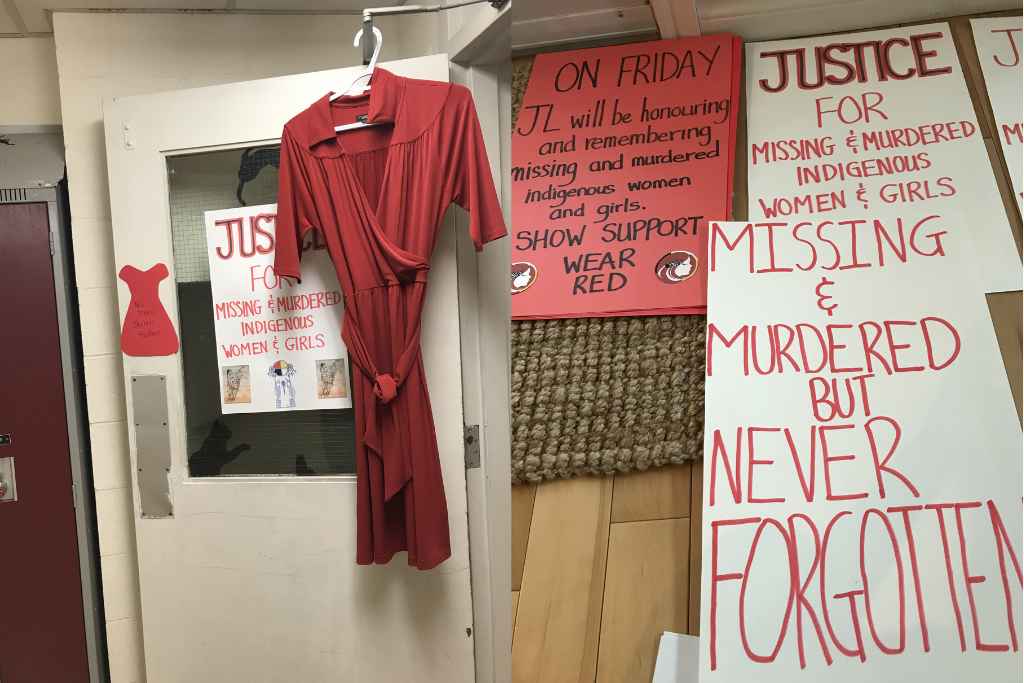
Posters created by Keilidh in recognition of Red Dress Day, displayed at her school and at Pathways Spryfield.
“I felt so supported,” she says. “They were right beside me, cheering me on. It gave me confidence to know that I had people in my corner.”
Keilidh took on other initiatives throughout high school. In Grade 12, she organized an event at her school in support of the Wet’suwet’en people in British Columbia, who were opposing the construction of a natural gas pipeline on their traditional lands. She brought together students and teachers to learn more about the issue. Pathways team members also came out to take part.
“The staff were always very supportive of what I wanted to do,” says Keilidh. “They gave me that space to learn, to make mistakes, and to speak in my own name, which is a very important thing—to speak in your own name and with your own voice.”
When Keilidh applied for post-secondary studies, her Pathways support worker wrote her a letter of recommendation for the TD Community Leadership Scholarship. The scholarship awards up to $70,000 toward tuition and living expenses to students demonstrating an outstanding commitment to their community. Keilidh was one of 12 students across Canada to receive the scholarship that year. “It was such a huge help because I had my undergrad significantly supported through this scholarship,” she says.
In 2020, Keilidh enrolled in the chemistry program at Dalhousie University with the goal of going on to medical school. Alongside a heavy courseload, she continued her community work. She founded the university’s first Indigenous women’s group called Mu Punkmutnaluk Nkwe’ji’jna’q (No More Stolen Sisters) Indigenous Women’s Group.
“On Turtle Island, Indigenous women have the highest rates of going missing, being murdered, and experiencing violence,” Keilidh explains. “I wanted to create a group where we could demand justice, honour our stolen relatives, support each other and have a safe space for discussion and cultural activities.”
During her undergrad, Keilidh returned to Pathways Spryfield, this time as a volunteer. She helped students study for exams and choose their post-secondary courses. “I wanted to give back to the community that inspired me in my academic and political work,” she says.
Keilidh also wanted to introduce new Indigenous programming activities for students. On one occasion, she invited a local Métis artist to facilitate a beading session. As she explains, “beading is not only a form of art, it’s also a form of storytelling,” and the session gave both Indigenous and non-Indigenous students the space to create and connect. In 2023, she organized field trips for Pathways youth to attend the North American Indigenous Games in Halifax. It was a chance to support Indigenous athletes and learn about the role of sports within Mi’kmaw communities.
Now in her second year of medical school at Dalhousie University, Keilidh hopes to continue working with Indigenous youth and communities and fighting for justice, building on the strong commitment she has always held.
As she reflects on her time at Pathways, she thinks of it as a place where young people’s ideas are taken seriously. “They trusted in what we were doing, what we believed in, and what we saw for the future of our community and our world,” says Keilidh. “That encouragement and support were vital to me.”
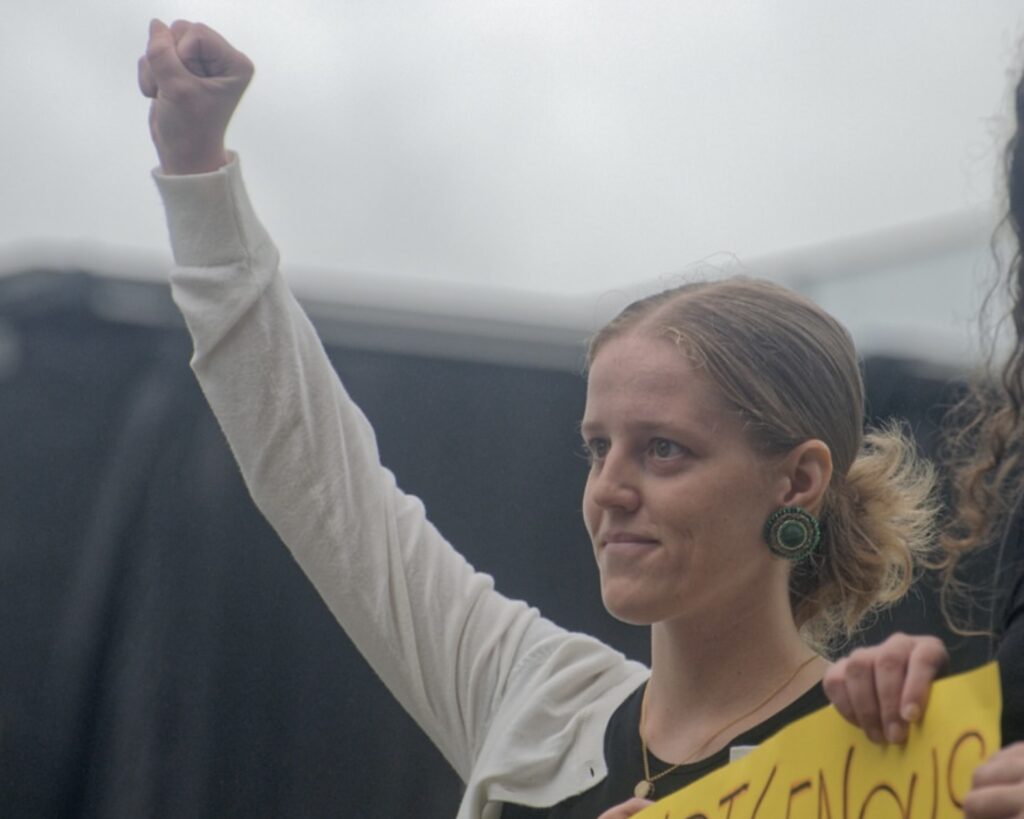
Keilidh joins a rally in support of the Dalhousie Faculty Association, advocating for job security and stronger protections for precarious academic workers.